

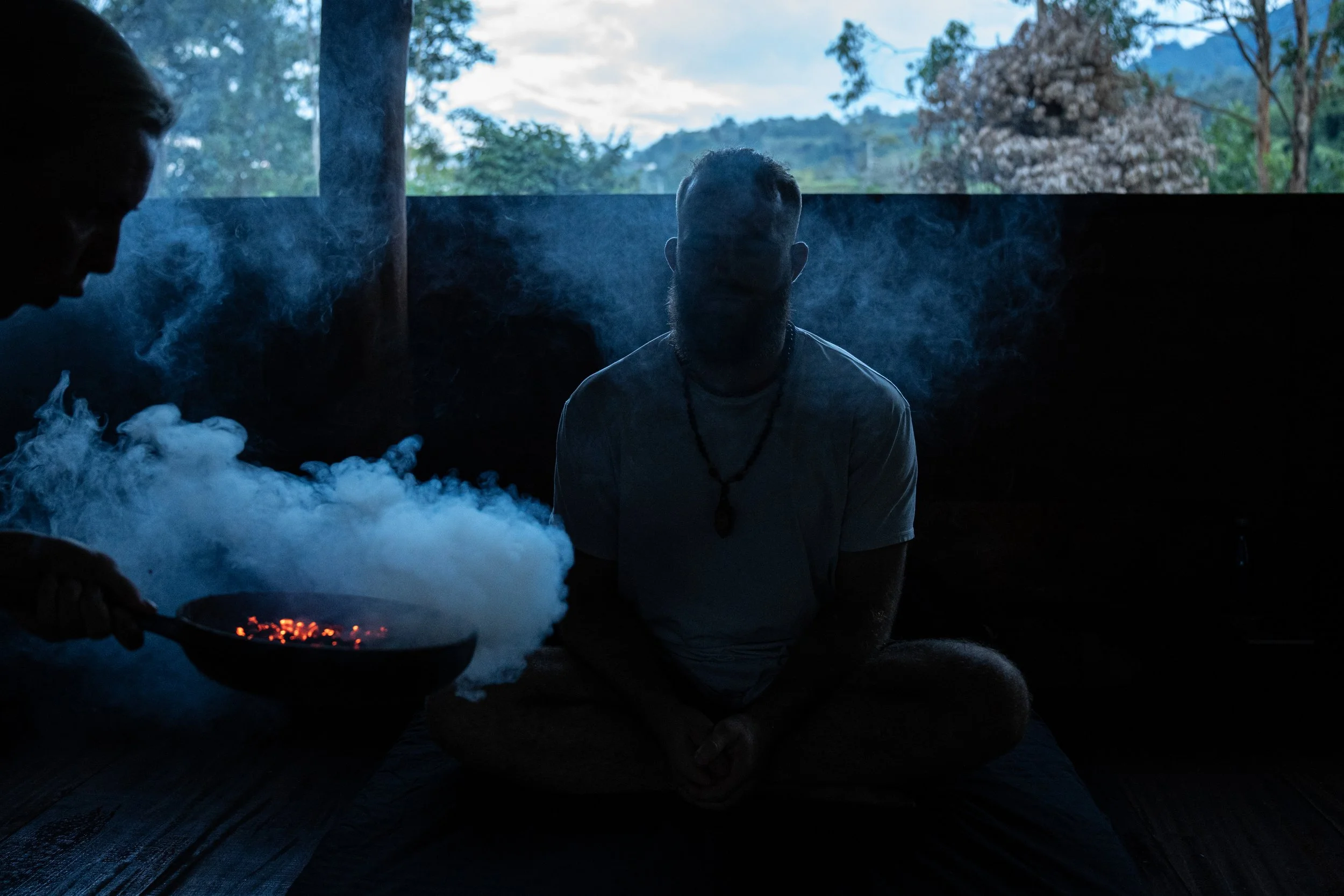
When the sport ends, the fire doesn’t. By Jared Fekete.
I wrestled in college. Four years of practice every afternoon, weight cuts, bus rides, and the same guys every single day. They were my people.
Then I graduated, and it was gone. Nobody stood up at a last practice and said, “This is over, here is what it meant, here is what you do now.” It just stopped.
If you’ve competed, you know this. Maybe it was your last fight. Maybe it was a contract that didn’t come back, a doctor’s note, or a broken body that wouldn’t do it anymore. The sport ends.
What nobody warns you about is that the sport stoked something in you, and that flame doesn’t just go away when it ends. Years of training a body to want intensity, and then the intensity stops, and the body still wants it. Missing the team is the easy part to say out loud. The hard part is sitting with all that fire with nowhere to put it.
I didn’t have words for that back then. So I did what any lost boy with college loans to pay off would do, and I applied to Officer Candidates School.
Why so many athletes and veterans feel lost after the fight?
I want to say I joined the Marine Corps to serve. That was in there. But the truth is I wanted to be put through something. The training. A war story. I wanted an ordeal that would take the man I was and hand back a better one. I wanted a tribe again—people who understood how I felt. And eventually, someday, I wanted to go back home and show my family how transformed I was.
Malidoma Somé, a teacher from the Dagara people of West Africa, spent his life writing about initiation, the hard road a young person walks to become an adult. In his account, initiation has three parts. The ordeal is run by elders who know you and know what it’s for. The whole village raises you toward it. And the village is waiting when you come back, ready to recognize the gift you carry and to put it to use. The return is what finishes it.
Somé also describes the person who never gets that return. They carry a fire that won’t go out and won’t let them settle. Left alone long enough, that fire turns and consumes everything around them.
I recognized almost every fighter I’ve trained with in that description. Fighters are people who found a channel for the fire. The problem is that the channel always closes, and we are forced to adapt.
Mine closed twice. I found personal value during my time in the Marines, but let’s be honest: the organization is a bit more focused on sending individuals to a foreign country than on bringing them home. When my time ended, my DD-214 and divorce papers arrived together. I was carrying guilt and shame with no place to set them down, and nobody whose job was to ask what I’d been through.
That isn’t only a personal failure, and if you’re living something similar, I don’t think you should treat it as yours either. A culture that sends people out to fight, whether on a mat, in a cage, or overseas, and never builds the road back, will keep producing people whose fire turns on them.
Addiction is a search for connection.
For a lot of us, the fire finds a bottle. Or pills. Or the next fight, the next business, the next thing to win. Gabor Maté, a physician who has spent his career working with addiction, says the question isn’t why the addiction. It’s why the pain.
Every addiction I’ve had was doing a job for me. It kept me away from feelings I learned early not to feel. Somewhere young, a lot of us decided that who we were wasn’t enough, so we started performing. Our worth moved outside us, into the scoreboard, the belt, the rankings, the followers. When the performing stops, the pain it was covering is still there, and we reach for whatever quiets it.
Under all that craving, I think what we’re after is connection. We’re trying to get home.
I was trying long before I knew it. At thirteen, I was hooked on pills, and I sabotaged my way into an emergency room, scaring my mother half to death on the way. I’ll come back to that night in a bit.
What psychedelic ceremony offers that a clinic room can’t.
Most of the public conversation about psychedelics and athletes is about the brain, and it should be. Many of us have taken more hits to the head than anyone should, and the research Athletes Journey Home supports through its partner, Onaya, matters. I’m not a scientist, and I won’t tell you what a medicine does to your neurons.
I want to talk about the other half. Not what happens inside your head, but who is in the room with you, and who is waiting when you walk out.
Psychedelics are entering Western medicine mostly in one shape: one patient, a clinician taking notes, a plain room designed so nothing gets in. That shape has real strengths. It’s also the shape our culture gives almost all inner work: one person, one professional, one hour.
During my last years in the Corps and all the way through the divorce, I may or may not have been growing and eating mushrooms. Allegedly, they got me through some deep water, and somewhere in there they started pointing me toward the jungle.
So after the Corps, I went to the Amazon and sat in a different kind of room. A maloca, a ceremonial house, with maestros singing icaros, the healing songs of that tradition. A special diet before and after. Plant baths. And a jungle reorienting me to the larger web of life. The people caring for me didn’t feel like retreat staff. They invited me onto their land and into their home, and they cared for me. They felt like long-lost family.
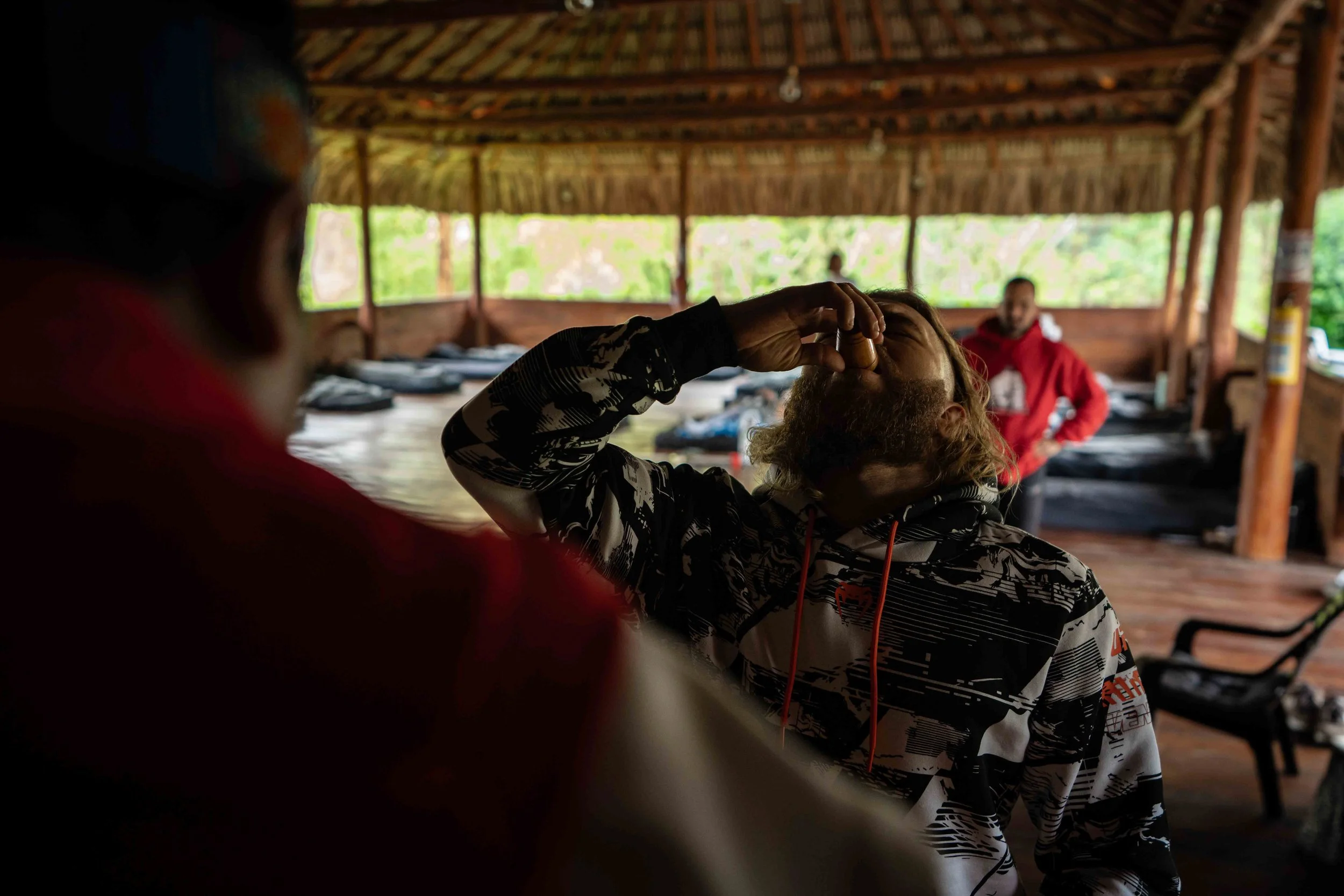
It was the hardest thing I’ve done. The medicine took me through my life and showed me my failures, then further back through the men in my family line and how they’d failed their wives, their kids, and the Earth. She didn’t spare me any of it. But she softened me enough to take it as lessons instead of verdicts, and forgiveness was a huge part of the process.
Several ceremonies later, in a different part of the world, she took me somewhere I didn’t expect: back to that emergency room at thirteen, and back into the full, blissful warmth of the Dilaudid they gave me there. This time I wasn’t scared, and I wasn’t fighting anything. I was held.
I have a theory that somewhere along the line, most of us came to believe our mothers abandoned us. Maybe it happened, maybe it only felt that way to a child, but the belief sticks. And I think it spreads. Carried by enough of us, across enough generations, it becomes a story the whole culture tells: that nature, the archetypal Mother, has abandoned us too. So we stop trusting the ground that made us. We build cities and screens and systems that stand in for the garden we were born into, and pills and scoreboards move into the same gap. In that ceremony, something in me stopped bracing against a mother’s love and softened into it. I’m still learning what to do with that, but a bond that broke when I was a boy began to mend there in that memory.
Coming home means having someone to come home to.
Ian McCall says the athlete’s journey home is a return to themselves. I believe that. The medicine gave me back pieces of myself I thought were gone. But there’s more to the story. You return to yourself, and then you need somewhere to return to: people who see what you’re carrying and need it.
As I reflect on 25-plus ceremonies, I am discovering this. I met my girlfriend on that first trip, too soon after the divorce by any sensible measure, but she was an incredible mirror for working through the pain it stirred up. Nobody in that hut was performing, and we met each other raw.
She wasn’t the only one I met. Ceremony by ceremony, a tribe has been gathering: fighters, veterans, and seekers who have gone through the same nights and come out on the same frequency, speaking the same language. In Somé’s village, the community comes first. It raises you, sends you out, and waits for you. For me, and for most of us in this Western culture doing the same work, the ordeal came first. The village is something we’re building after, together, out of the people who understand.
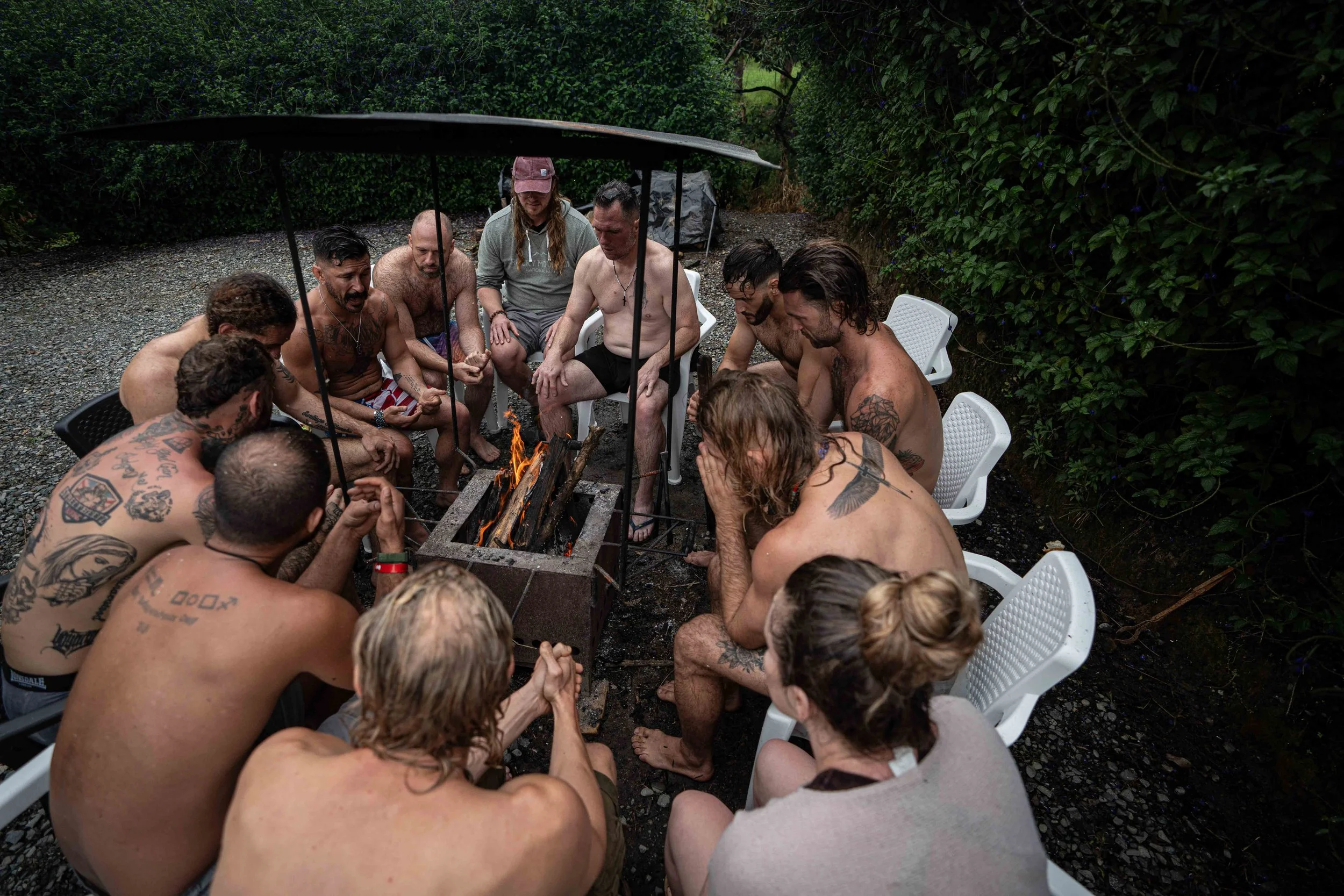
Some of that village lives at LaWayra, a retreat center an hour south of Medellín, Colombia, where Athletes Journey Home has brought fighters to sit together. Those fighter retreats were born from a vision. Before he and Ian had ever met, LaWayra’s founder, Sam Believ, saw Khabib Nurmagomedov and Conor McGregor, two of the fiercest rivals the sport has known, sitting together in an ayahuasca ceremony and finding peace. Then he met Ian. I can’t call that timing anything but divine. What stands out to me there is how deliberately trust is built. The Taita, the facilitators, and the people who keep the place running treat safety as the first job. You’re prepared before the medicine, cared for through the night, and given space to talk it through after. That trust is what lets a guarded person relax, and fighters are about as guarded as people come. Once you relax, you can finally meet yourself, process what comes up, and actually feel it. They run a beautiful retreat year-round for anyone who feels called. If you decide to go, tell them Jared sent you. (Disclosure: I receive a referral benefit if you do.)
Scattered around the world as it is, the web we’re weaving is a real place to come home to. It’s built on support, love, and forgiveness, the things most of us were never handed when the fight ended. Nobody in it asks you to perform. It reconnects you with who you were before you learned to, your real essence, and with the living force of nature that keeps helping us remember.
For me, that remembering has grown into a pull toward land. I want a family, ground to tend, and a community I can walk to. I want to keep remembering what we came here to do and pass that memory on to the ones who come after us. I don’t yet know whether a web like ours can do everything a village can, but I can’t think of anything more worth trying.
About the author
Jared Fekete is a former Marine Corps Combat Engineer Officer and a doctoral student in Jungian and Archetypal Studies at Pacifica Graduate Institute. He wrestled at Wheaton College and for the All-Marine and All-Navy wrestling teams, fought in amateur MMA, and is a brown belt in Brazilian jiu-jitsu. He won the Season 9 team title with the Las Vegas Kings in the Professional Grappling Federation (PGF). He is in the early years of an education in the Yagé and Shipibo ayahuasca traditions, with more than 25 ceremonies in the past three years. He teaches jiu-jitsu at Operation Purify, a healing retreat for veterans in Los Llanos, Colombia, and writes about initiation, community, and the road home.
If you’re an athlete or veteran looking for your way home, Athletes Journey Home connects retired athletes with mental health and wellness resources and supports research into new approaches to TBI recovery. Reach out or support the work here.